Categories
Presentations

Educators’ Forum: Strategies for Wellness

Jason Butler and I co-facilitated this embodied panel and workshop at the meeting of the North American Drama Therapy Association in Yosemite, CA. As the fourth annual Educators’ Forum, this workshop once again created space for drama therapy educators to come together for support and collaboration. In connection with that year’s theme, we looked at ideas of balance and wellness as they apply to the drama therapy educator. In particular, we examined the day-to-day strategies that assist educators in maintaining balance and a personal sense of wellness. Participants were invited to bring strategies that work for them as well as situations that cause difficulty. Together we actively explored the contradictions and paradoxes inherent in drama therapy education and work to facilitate harmony and balance.

Participants will also heard about our recent explorations and collaborations bridging the fields of drama therapy and applied theatre as we had recently co-presented at two international applied and educational theatre conferences. Our experiences and findings were shared and these were collectively investigated with participants alongside other ways that other related fields can inform the education and practice of drama therapy. 

Finally, we  examined how drama therapists can better collaborate with applied theatre initiatives in order to expand the exposure of the field and create more opportunities for teaching drama therapy and expanding the profession. 

Below are some images of the participants embodying scenarios and themes of drama therapy education:

Categories
Publications

Reflections on the Life of Maxine Greene and the Forum on the Teaching Artist: Navigation, Innovation, and Sustainability

As one of Dr. Greene’s last students at Columbia University, I proudly recruited her to deliver a keynote address on the opening night of NYU’s annual forum, for which I was the organizing manager. Sadly, this would become Maxine’s final public appearance before she did later that year. In this blog post, I recount a few more precious details about that night and the conference at large.

Revue, Fall.

http://steinhardt.nyu.edu/site/revue/2014/10/reflections-on-the-life-of-maxine-greene-and-the-forum-on-the-teaching-artist-navigation-innovation-and-sustainability/

Categories
Community Engagement

Sacred Play: Enacting Forgiveness

Atonement on Yom Kippur can be deepened through imagination, community-building, and sacred play. Alongside Shoshana Jedwab (and once with her partner Jill Hammer), I have developed and facilitated several creative breakout sessions preceding the final prayer service, Neilah. Dramatic strategies have helped me create unique spaces for engaging, immersive prayer at Romemu. Informed by expressive arts therapy practices, we adapt and interweave text, liturgical imagery, and ritual group activities that diverge from–yet complement–the sanctuary process. Over the years, we have found best practices and concepts to safely structure embodied teshuva (meaning “return”) experiences that ignite participants’ whole self to connect with each other and Source.

ROMEMU YOM KIPPUR BREAKOUT SESSIONS

Teshuva Labyrinth

Saturday, October 4, 2014

Andrew Gaines, Rabbi Jill Hammer, and Shoshana Jedwab

A labyrinth is an ancient technology for meditation and transformation through walking a sacred pattern or circuit. On Yom Kippur during biblical times, the high priest would also walk a labyrinthine journey through the Temple, to the Holy of Holies and the Divine Presence, and then slowly recede. We will offer texts, visualizations, and a labyrinth path to help you frame your experience and prepare for the coming year, but the Teshuva journey itself is co-created by you and your Source.

Between the Cherubs: Embodied Teshuva

Saturday, September 14, 2013

Andrew Gaines and Shoshana Jedwab

The High Priest was only permitted to enter the Holy of Holies on Yom Kippur. Inside lived the ark, adorned only by two cherubs facing each other, with an empty space between them. Inspired by liturgical text and imagery, and informed by creative arts therapy practices, we will collectively invoke a playful safe space to embody the practices of the High Priest. Together we will co-create a spiritual journey towards teshuvah, making conscious preparations for the concluding Neilah service, encountering the gateway to mystery.

Enacting Forgiveness

Wednesday, September 26, 2012

Andrew Gaines and Shoshana Jedwab

Deepen your renewal through the support of your imagination, our community, and stories from our sacred texts. Shoshana and Andrew will safely guide us to dramatize the teshuva journey with techniques adapted from Bibliodrama and Drama Therapy. To create this magical experience, please arrive on time as latecomers cannot be admitted. No acting experience is necessary; participants must be at least 14 years old.

Categories
Presentations

Ethical Praxis Discourse: Theatre, Education, Therapy, and Activism

 
How can socially-engaged and educational theatre/drama ethically serve marginalized and vulnerable populations? As Chair of this panel including Ashley Forman, David Montgomery, and Juliana Saxton, we explored answers and unearthed deeper questions at the American Alliance for Theatre and Education conference in Denver, CO.
 
Despite our best intentions, the terrain at the intersections of theory/practice and aesthetics/instrumentality can shift unpredictably, and we risk undermining the very populations we aim to empower.  Our discussion gained firmer footing through a series of subquestions to navigate overlaps, boundaries, and interstices found at this junction:
  • When does our work become too emotional or too personal?
  • What is the difference between therapy and therapeutic?
  • How are at-risk populations’ needs addressed?
  • How can we train facilitators and artists to manage these ethical dilemmas?
Our format also decentralized the discussion away from traditional didactics and democratized the discourse through Weaver’s “Long Table” experimental public forum: Concentric circles of chairs surrounded a single table covered with paper, with its own collection of chairs, occupied in part, by the hosts. Microphones and refreshments also adorned the table.  At any time, attendees were invited to fill the remaining chairs, and augment–or shift–the conversation.  In action, the Long Table became a metaphor for radical inclusion as we shared the fruits of our labors, collectively addressed the problems posed, and dramatically built community ties.
 
Etiquette for participation was read aloud and distributed to each participant:
 
There is no beginning
 
It is a performance of a breakfast, lunch or dinner
Those seated at the table are the performers  
 
The menu is up to you 
Talk is the only course
 
There is no hostess 
It is a democracy  
 
To participate, take a seat at the table  
 
If the table is full, you can request a seat
Once you leave the table you can come back  
 
There can be silence 
You can break the silence with a question
You can write your questions on the table
There can be laughter  
 
There is no conclusion


Categories
Community Engagement

Jewish Topography: Shmoozing in Action

Each year, NYC’s Jewish Community Center celebrates the holiday of Shavuot with an all-night learning event, Tikkun, meaning “heal.” Jews of all races, denominations, genders, ages, orientations, and levels of observance attended my session, inviting them to “delve, encounter, connect, and discover the breadth and depth of our communal and individual identities through a series of engaging and dynamic discussions.” Utilizing cultural mapping and sociometric games and exercises, I facilitated fascinating encounters and discussions about the visible and invisible lines that divide and connect us.

Jewish Topography was a play on Jewish Geography–a name given to the little social game some Jews play in search of a shared connection or network. For instance, when another Jew learns that I was born and raised in Phoenix, Arizona they might start asking if I know a local Rabbi or another Jew who lives there. Turns out, this game was played when I was dating my wife by her family and earned me a few more dates! In this workshop, rather than exploring who we know, we were traversing the diversity of who we are–the variety and contours that make up our cultural identities.

Categories
Community Engagement Productions

Shushan Night Live

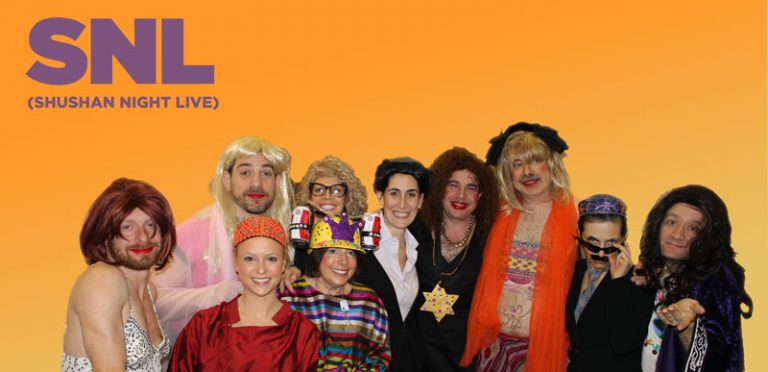
I co-authored, directed, and performed in this community-engaged Theatre of Faith performance project on The Book of Esther at Romemu synagogue, framed shamelessly around the structures and sketches of Saturday Night Live.

Our “Cold Open” was Caveman Lawyer defending King Ahashverosh against Vashti over her refusal to dance, and from there we were off to the races with other classics: Opening Monologue, Celebrity Jeopardy, Church Chat, Weekend Update, Spoof Commercials, and classic ending moment–a live band playing the SNL Closing Theme (Waltz in A) as the cast and crew celebrated together on stage.

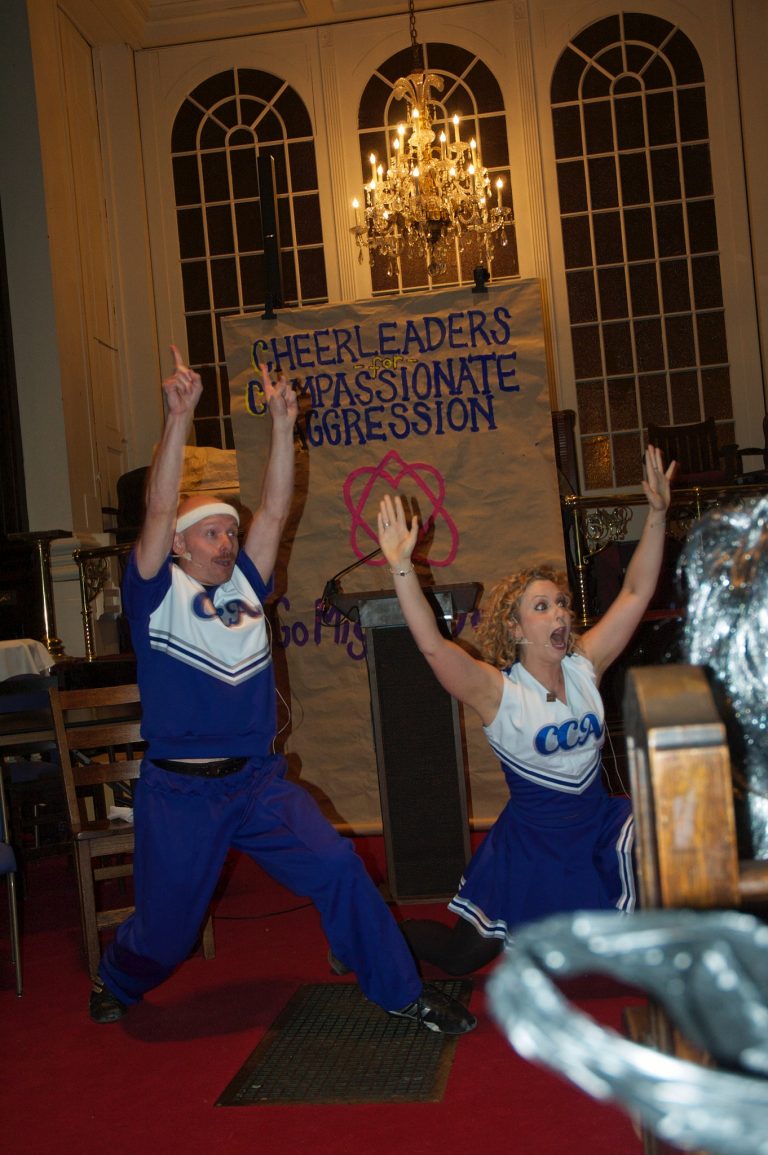
Below is our version of the Spartan Cheerleaders: Cheerleaders for Compassionate Aggression, which was our symbolic treatment of the war between the Jews and Persians in Chapter 10.

Categories
Community Engagement Productions

Shushan Style: A J-Pop Purim!?!

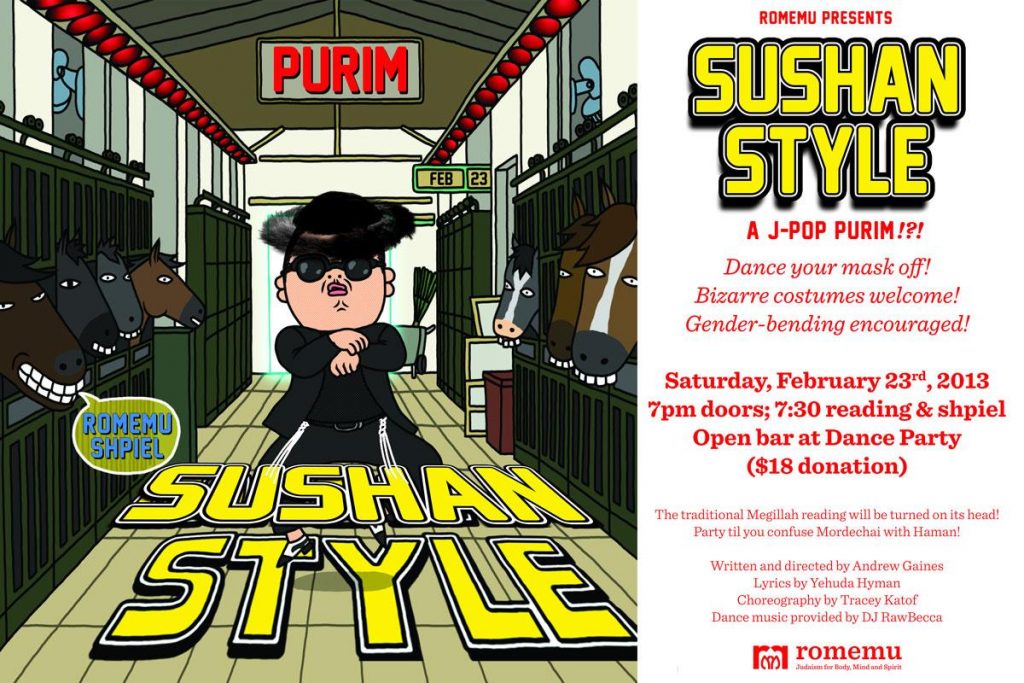
This was my 3rd Purim Shpiel at Romemu, a community-engaged Theatre of Faith performance project on The Book of Esther at Romemu synagogue.

This year’s concept was all based on popular media themes. One of my favorite moments was a slow motion battle fought with giant pencils to music from Les Misérables.

The title of the show was a spoof on Gangham Style, the Korean pop song/dance that had recently gone viral on YouTube. And of course, we performed our own version! Here is a clip of it to enjoy, followed by a little sketch based on The Apprentice featuring the Rabbi’s wife playing him to the sheer delight of our audience.

Categories
Community Engagement

Hurricane Sandy Puppet Project


In the weeks following Hurricane Sandy, children were among the most neglected bystanders. My collaborator David Schechter and I travelled to Far Rockaway Beach in Queens, NY to contribute a puppet performance to the Rockaway Kids Carnival.

We rented a van to bring fellow volunteers to the site and used the back as a makeshift performance space. 

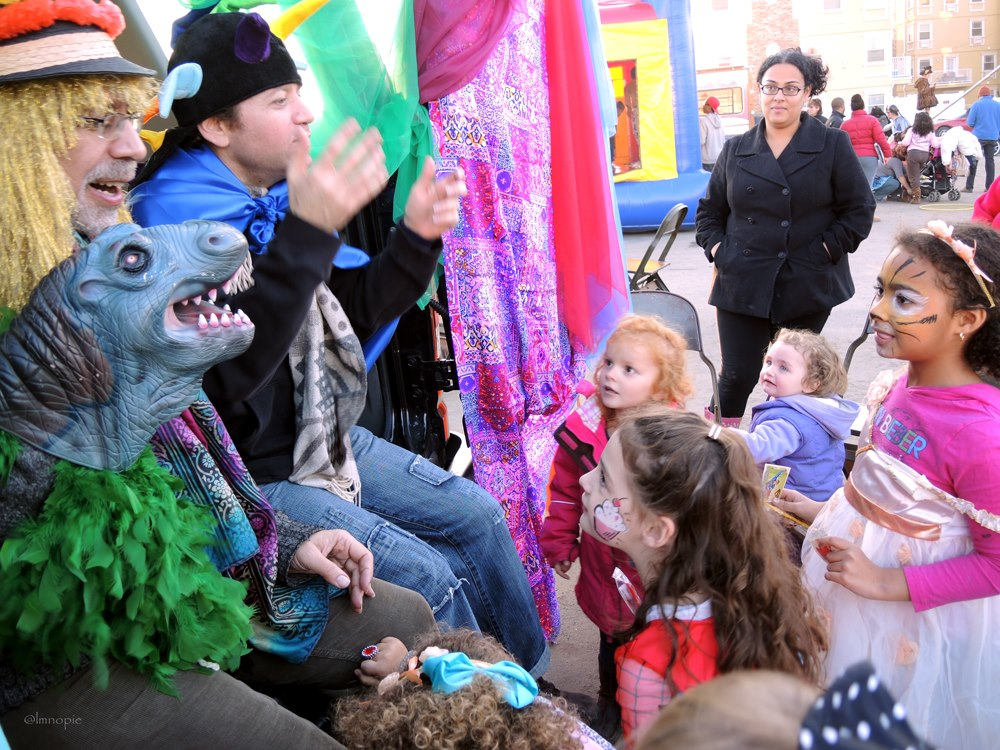
David Schechter and I absolutely LOVED performing these puppet shows for the kids. In this moment below, we are singing with/to the Dinosaur Lady to persuade her to set free one of our captured puppet friends.

The interplay of all our imaginations was deep fun and clearly healing for everyone, including the onlooking adults! Through the distance of puppets, children and their families appeared to experience needed joy and hope, and the experience served as a powerful testimony for the healing power of applied theatre. Thank you to Mark Winkel for organizing, and Occupy Sandy Relief NYC for the photo above.


In the weeks following Hurricane Sandy, children were among the most neglected bystanders. My collaborator David Schechter and I travelled to Far Rockaway Beach in Queens, NY to contribute a puppet performance to the Rockaway Kids Carnival.

We rented a van to bring fellow volunteers to the site and used the back as a makeshift performance space. 

David Schechter and I absolutely LOVED performing these puppet shows for the kids. In this moment below, we are singing with/to the Dinosaur Lady to persuade her to set free one of our captured puppet friends.

The interplay of all our imaginations was deep fun and clearly healing for everyone, including the onlooking adults! Through the distance of puppets, children and their families appeared to experience needed joy and hope, and the experience served as a powerful testimony for the healing power of applied theatre. Thank you to Mark Winkel for organizing, and Occupy Sandy Relief NYC for the photo above.


Categories
Publications

Reflections on Traumatized Drama Therapists

Cover art from NADTA Conference, “Witness the Dark.”

In this invited blog post, my colleague Lucy McLellan and share about the our upcoming presentation at the North American Drama Therapy Association’s conference themed on trauma.

Categories
Community Engagement

FACES Teen Health Education Theatre: Maimonides Medical Center

In 2012, I was hired as the new Director of FACES, Maimonides Medical Center’s teen health educational company in Borough Park, Brooklyn. I left Interfaith Medical Center after nearly 8 years for the opportunity to more fully integrate my clinical skills with pedagogy, artistic expression, and civic activism. Together with a diverse cast of teenagers, two drama therapy interns, and a small staff, we devised original performances relevant to their lives and those of our audiences.

Created by a social worker named Susan Montez over thirty years prior, FACES was turned over to me in need of modernization. Teens were performing scenes written in the 1980s, the presentation format was too passive for my taste, PR materials were outdated, and there was no website to speak of. Too few people knew that Zoe Saldana began her career as a FACES teenager.

If all this wasn’t enough, the community has been fracturing over the years; petty disagreements and miscommunications led to participants feeling ostracized and alienated from members who had since moved on.

Needless to say, I pounced on all of the above with fervor. I reconnected with FACES’ lapsed membership, facilitated teambuilding experiences, and created the program’s first website. My supervisor, Dr. Alan Hilfer, charged me with presenting a show to the Maimonides Child and Adolescent Outpatient Services summer camp program within my first month. I focused on finding ways to include the audience into our scenes, sometimes directly, and other times obliquely; I consistently asked the young performers, “How can we enrole the audience in this scene?” The technique not only garnered powerful responses and participation from the spectators, but it also aided the performers in finding organic ways to connect with the audience, aesthetically, vocally and visually. I also began mentoring the teens in rewriting old scenes and generating new plays to reflect their perspectives.

Meanwhile, during my first day on the job, the Grants Officer broke this news: FACES had lost its federal and state funding due to drastic Medicaid reforms. I was devastated. My staff, interns, and I soldiered on until the closure. My focus expanded to include devising ways to create a healthy, meaningful closure of the program. We invited members from the past 30 years to reunite, say goodbye to Susan, the space, and share memories. The finishing touch was creating a puzzle of the FACES logo. On our way out, we each took a piece to represent the dismantling, but also the missing pieces we each held always connecting us.

Despite the untimely demise of FACES, I am so grateful to have met and worked with the inspiring teens and decades of members. The experience also woke me up to the harsh realities of non-profit theatre organizations, especially within the medical arena, and our country’s growing trend towards undervaluing mental heath and community service.